
 3
3 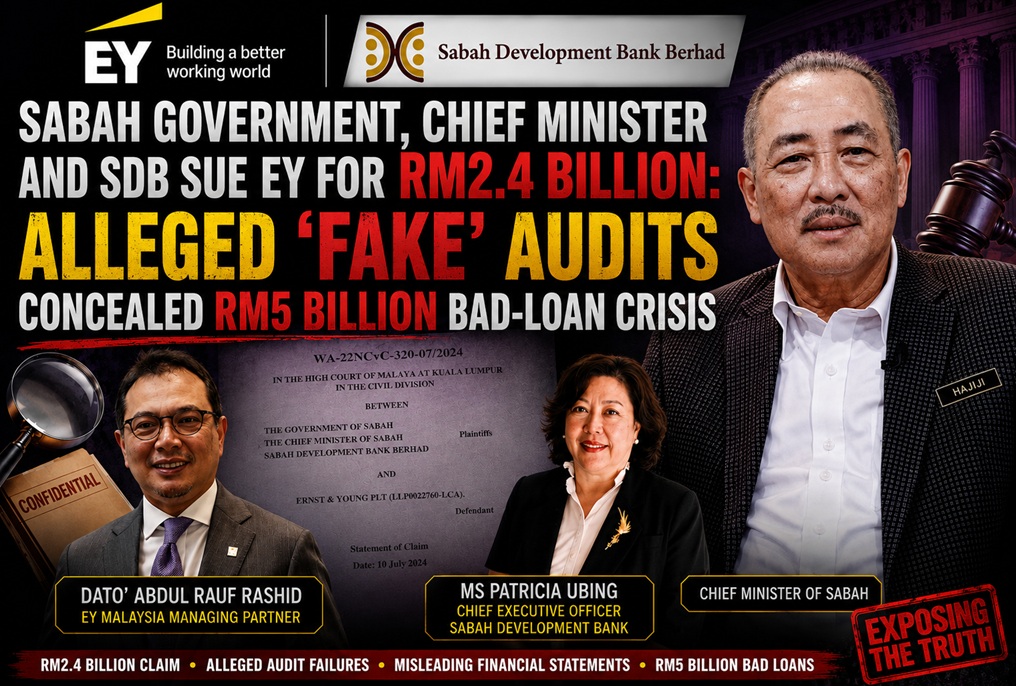
The Sabah Government and Sabah Development Bank Berhad (SDB) allege that EY certified SDB’s accounts as giving a “true and fair” view despite claims that the bank was insolvent, relied on outdated collateral valuations and engaged in the “evergreening” of loans.
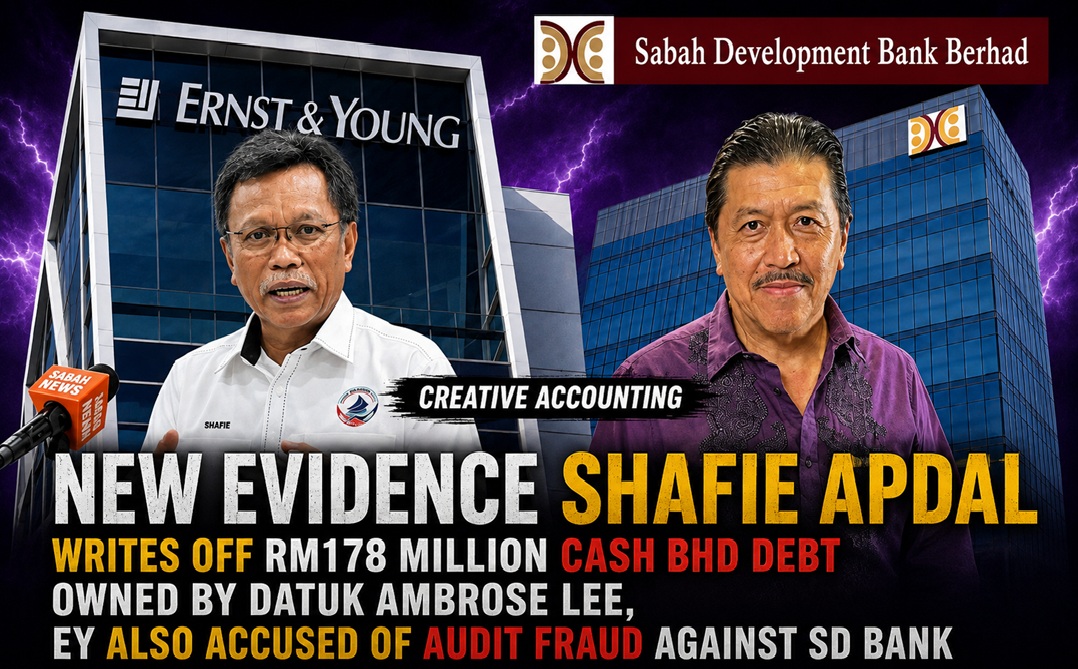
In line with Sabahkini2’s earlier exposé concerning allegations that the administration during the era of Datuk Seri Mohd Shafie Apdal approved the write-off of RM178 million in debt involving Construction and Supplies House Bhd (CASH Bhd), owned by Datuk Joseph Ambrose Lee, another major development has now emerged involving Sabah Development Bank Berhad (SDB).
RELATED ARTICLE — New Evidence: Shafie Apdal Allegedly Wrote Off RM178 Million Debt Owed by Datuk Ambrose Lee’s CASH Bhd, While EY Faces Lawsuit Over Alleged SD Bank Audit Fraud
The Sabah State Government, together with three state-owned entities, has filed a RM2.4 billion lawsuit against Ernst & Young PLT (EY), alleging that the international audit firm was negligent and breached its statutory duties in auditing SDB’s financial statements for more than a decade.
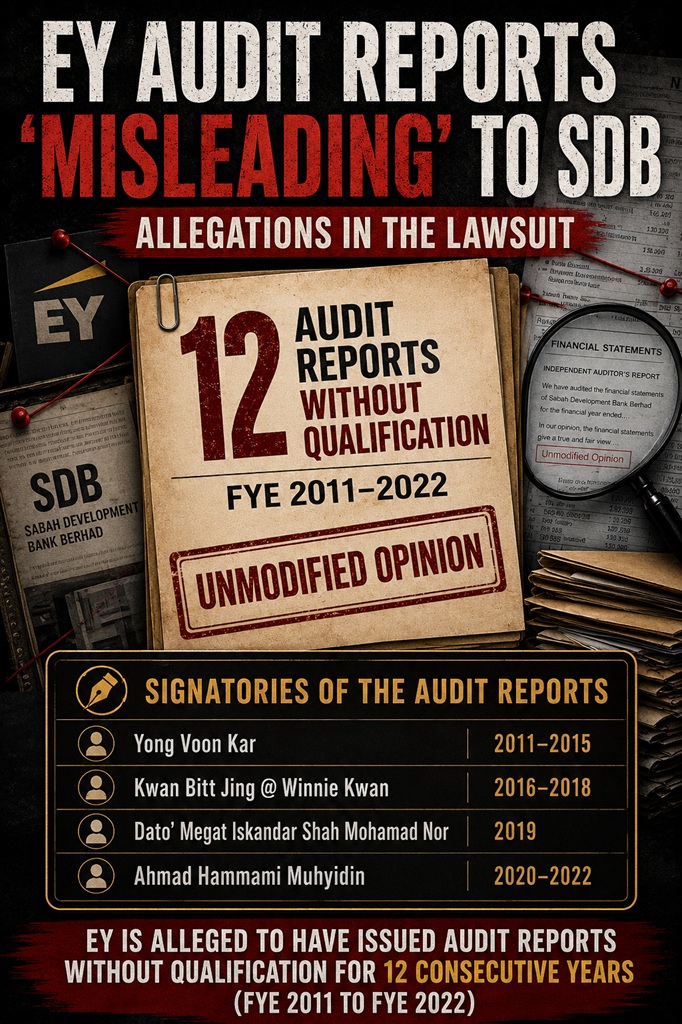
The action, filed at the Kuala Lumpur High Court on 30 July 2026, alleges that EY issued unqualified audit opinions for the financial years ended 2011 to 2022 despite indications that SDB’s financial position had seriously deteriorated.
The four plaintiffs are the State Government of Sabah; the Chief Minister of the State of Sabah as a corporation sole; Sabah Development Berhad; and SDB Corporation Sdn Bhd. EY is named as the sole defendant.
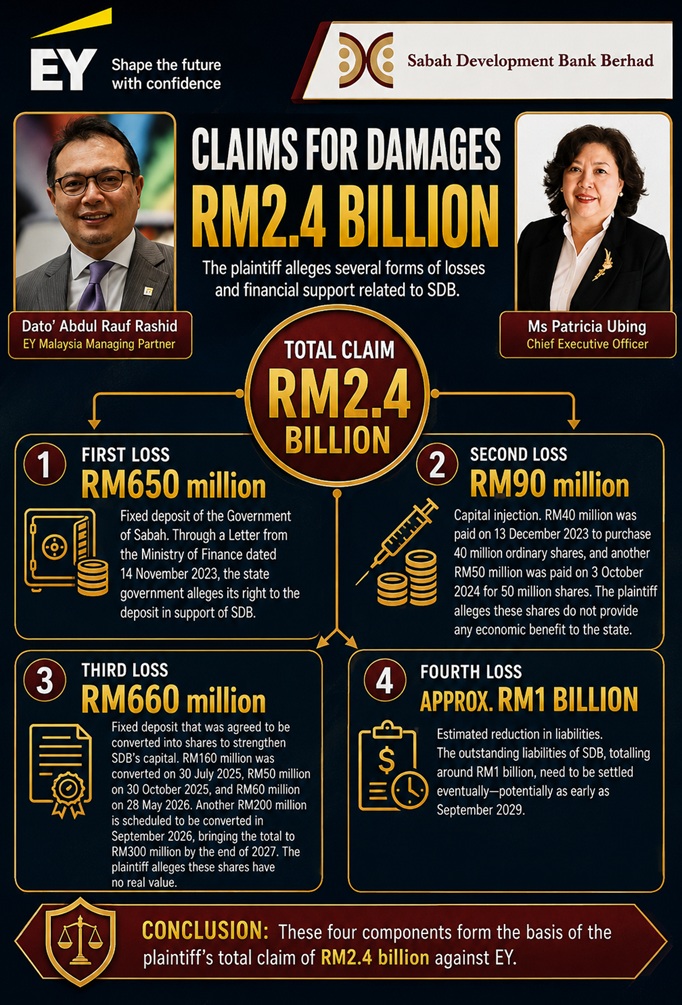
Through the action, the plaintiffs are seeking RM2.4 billion, comprising RM650 million in forfeited fixed deposits, a RM90 million capital injection, RM660 million in deposits agreed to be converted into redeemable preference shares, and approximately RM1 billion in continuing and future losses.
The plaintiffs are also seeking general damages, punitive and exemplary damages, pre-judgment interest, post-judgment interest at five per cent per annum, and costs.
EY Audited SDB for 13 Years
According to the Statement of Claim, EY became SDB’s statutory auditor in 2011 and continued auditing the Sabah Government-owned development bank through the 2023 financial year.
EY was not reappointed at SDB’s Annual General Meeting on 19 September 2024. Forvis Mazars PLT was subsequently appointed as the new auditor for the 2024 financial year after receiving professional clearance from EY on 26 September 2024.
Throughout the audit period, EY reportedly expressed the opinion that SDB’s consolidated and separate financial statements gave a “true and fair” view of the bank’s financial position.
The profit-before-tax figures contained in the audited accounts showed that SDB recorded profits every year from 2011 to 2022. These included RM91.37 million in 2011, RM177.57 million in 2017, RM111.60 million in 2018, RM139.32 million in 2019 and RM96.01 million in 2022.
That picture changed dramatically in 2023, when SDB recorded a loss before tax of RM878.05 million and a net loss of RM683.96 million.
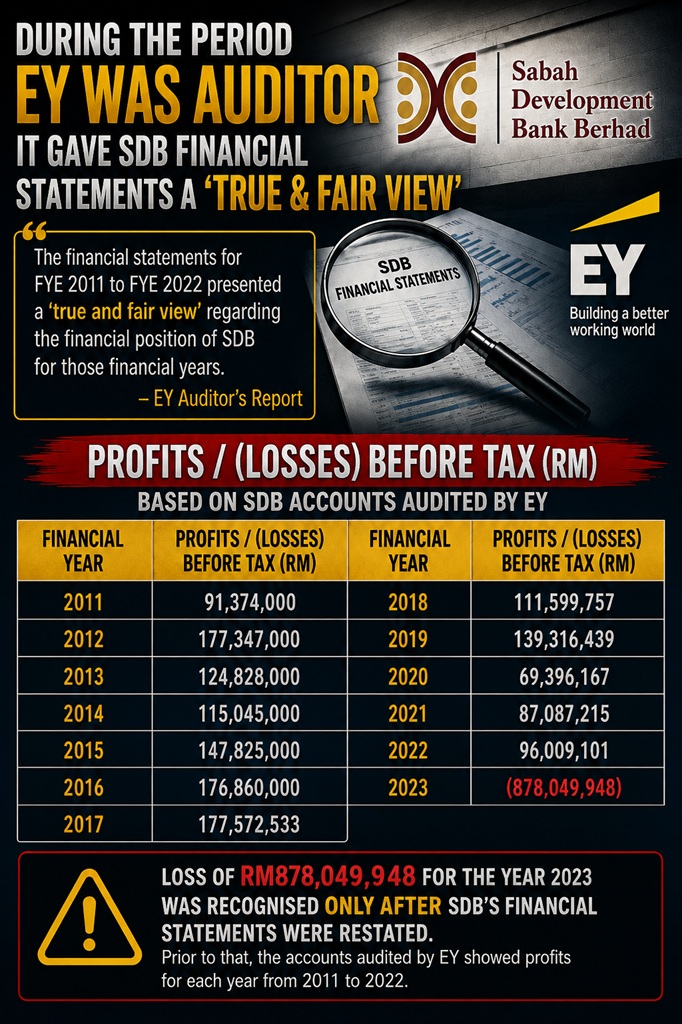
The sudden shift from years of reported profits to a loss approaching RM900 million forms one of the central grounds of the lawsuit. The plaintiffs allege that the losses reflected in the 2023 accounts were in fact the result of longstanding problems that EY should have identified, provided for and reported much earlier.
SDB Allegedly Insolvent Since 2018
The Statement of Claim alleges that SDB had become insolvent by no later than the 2018 financial year.
The allegation is based, among other things, on EY’s own reporting of the composition of SDB’s loan portfolio. In 2018, 53.96 per cent of gross loans were reportedly classified as non-performing loans (NPLs), while another 31.98 per cent were categorised as Stage 2 loans.
Combined, 85.94 per cent of SDB’s loan portfolio that year was either impaired or showing a significant increase in credit risk.
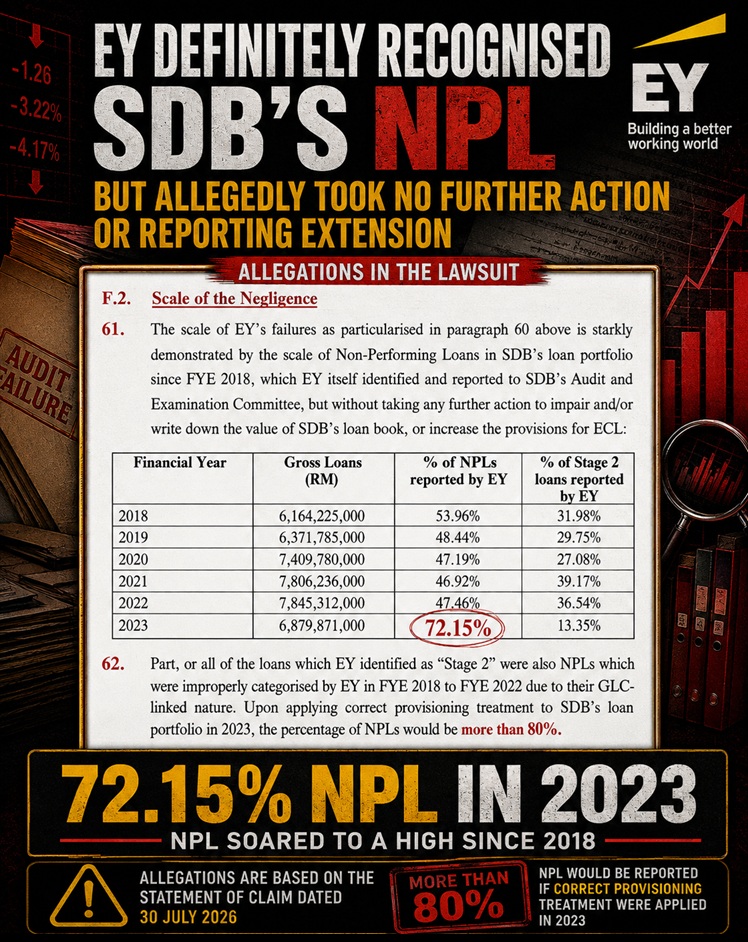
The plaintiffs allege that some loans classified as Stage 2 between 2018 and 2022 were in fact NPLs but were not properly classified because they were associated with government-linked companies.
When what the plaintiffs describe as the correct provisioning methodology was applied in 2023, SDB’s NPL ratio was allegedly supposed to exceed 80 per cent. The plaintiffs further claim that SDB’s actual average gross impaired-loan ratio between 2018 and 2022 also exceeded 80 per cent.
Based on those figures, the plaintiffs contend that a competent auditor could not reasonably have concluded that SDB’s impairment provisions were adequate, that its financial statements gave a true and fair view, or that SDB could continue as a going concern without qualification concerning its financial position.
Nearly RM5 Billion in Non-Performing Loans Uncovered
On 1 July 2023, SDB’s shareholder appointed a new Board of Directors. Datuk Seri Panglima Lim Haw Kuang was appointed Executive Chairman, while Patricia Ubing assumed the position of Chief Executive Officer on 1 September 2023.
A review conducted by the new board and management of the accounts from 2017 to 2022 allegedly uncovered several serious weaknesses.
Among them was the discovery that approximately RM5 billion, or nearly 70 per cent of SDB’s total loan portfolio, consisted of non-performing loans.
Of the RM6.8 billion in reported security assets, collateral amounting to RM5.195 billion was allegedly of questionable value because it was based on outdated or unreliable valuation reports, or valuations built on unrealistic assumptions.
Some valuations were allegedly based on construction cost estimates prepared by contractors or architects for projects that had already been abandoned. There were also allegations that the value of certain collateral assets had been overstated by hundreds of millions of ringgit.
Approximately 45 per cent of SDB’s loan portfolio in 2023 was also said to consist of loans to parties in Peninsular Malaysia. Of the approximately RM5 billion in NPLs, RM3 billion, or 60 per cent, was said to have originated from loans in Peninsular Malaysia.
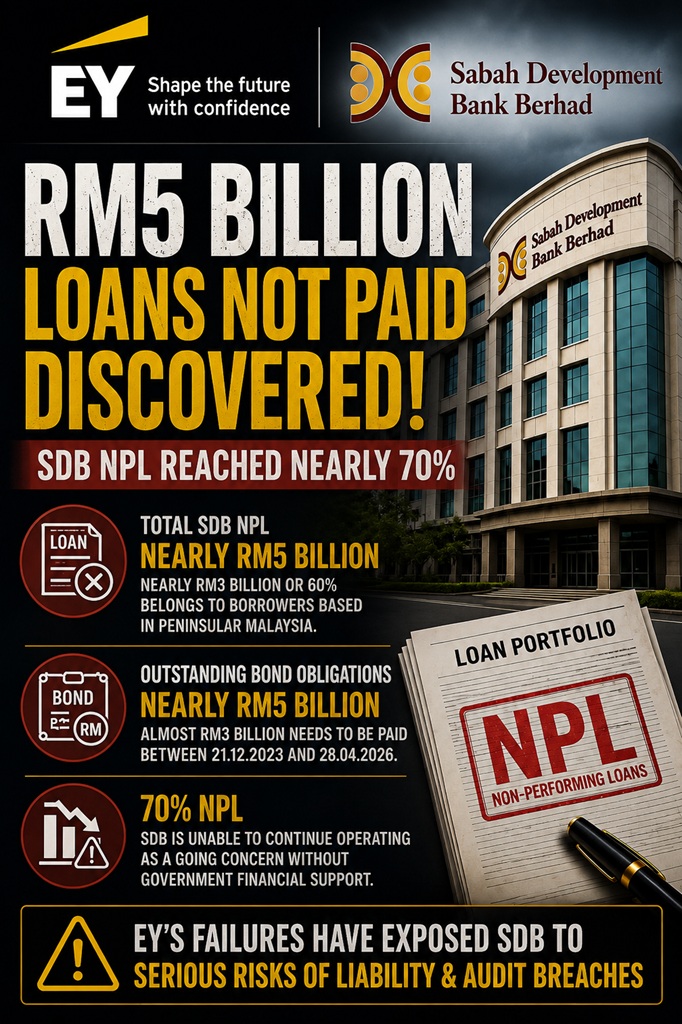
This has raised questions because SDB was established by the Sabah Government as a financial intermediary institution to finance development and deliver benefits to the people of Sabah.
New Loans Allegedly Used to Cover Old Loans
Among the most serious allegations is the alleged practice of loan “evergreening.”
Under this practice, new credit facilities were allegedly extended to borrowers who were no longer capable of servicing the principal or interest on their existing loans. Funds from the new facilities were then used to repay the old debts.
The accounting effect was that the old loans appeared to remain performing and therefore did not have to be classified as NPLs.
The Statement of Claim alleges that the practice created a false impression that the loans remained recoverable, reduced the amount of expected credit loss provisions and made SDB’s capital adequacy appear stronger than it actually was.
EY is alleged to have failed to identify and raise the practice as a serious internal-control weakness even though the relevant loan data and records were allegedly available for the auditor’s inspection.
The Statement of Claim also alleges that the absence of robust recovery efforts for delinquent loans further worsened SDB’s position. Where NPL information was inaccurate, management did not have a true picture of default rates and the recoverability of the loans.
This relates to the issue previously raised by Finance Minister Datuk Seri Masidi Manjun concerning how additional loans were allegedly extended during the Shafie Apdal administration to companies whose existing facilities were already non-performing.
CAR of 18.28 Per Cent Allegedly Should Have Been Only 3.62 Per Cent
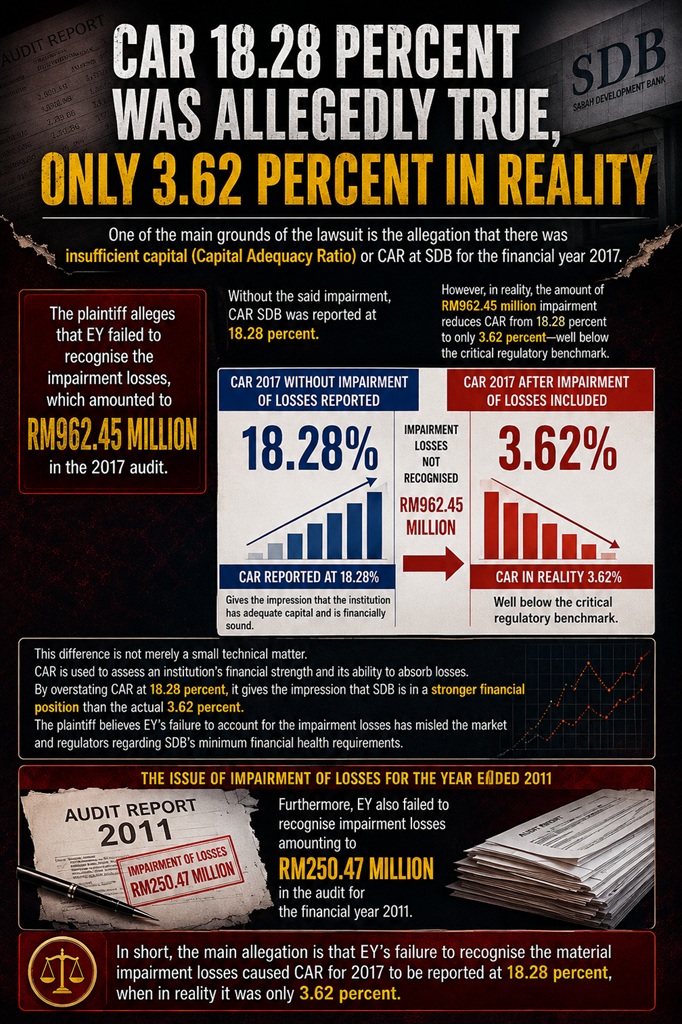
Another major basis of the lawsuit is the allegation that SDB’s capital adequacy ratio, or CAR, for the 2017 financial year was overstated.
The plaintiffs allege that EY failed to impose an additional impairment of RM962.45 million in its 2017 audit.
Without that impairment, SDB’s CAR was reported at 18.28 per cent. However, if the RM962.45 million had been taken into account, the plaintiffs allege that the actual CAR would have been only 3.62 per cent — far below the critical threshold of eight per cent.
The difference is not alleged to be a minor technical error. CAR is used to assess a financial institution’s ability to absorb losses. A CAR of 18.28 per cent therefore presents an institution as having a substantially stronger capital buffer than one with a CAR of just 3.62 per cent.
The plaintiffs contend that the failure to recognise the impairment concealed SDB’s failure to meet the minimum level of financial health expected of a bank.
EY is also alleged to have failed to impose an additional impairment of RM250.47 million in the audit for the 2011 financial year.
EY Allegedly Knew Collateral Was Valued Using Outdated Reports
The Statement of Claim refers to SDB’s Audit and Examination Committee Report for the 2020 financial year, which allegedly shows that EY was aware of problems involving collateral valuations.
According to the document, the latest valuation reports for 12 of 39 Stage 3 accounts were more than four years old. Four of those accounts relied on valuation reports that were more than seven years old.
EY itself was said to have reported that financial-services industry best practice required collateral valuations to be updated every two years.
Despite knowing that the reports were outdated, EY allegedly failed to insist that sufficient ECL and impairment provisions be recognised in the accounts.
The plaintiffs further allege that EY was aware of the need to recognise higher impairment charges but agreed to requests by SDB’s former management not to recognise the full amount because doing so would make it more difficult for SDB to obtain market financing and could adversely affect its bond programme.
If established through audit working papers, internal communications, meeting minutes or witness testimony, this allegation could become one of the most significant issues at trial. It goes beyond an alleged failure to detect a problem and asserts that the auditor was aware of the impairment issue but did not require the necessary adjustment to be made.
RM3 Billion Bond Programme Issued Based on Audit Reports
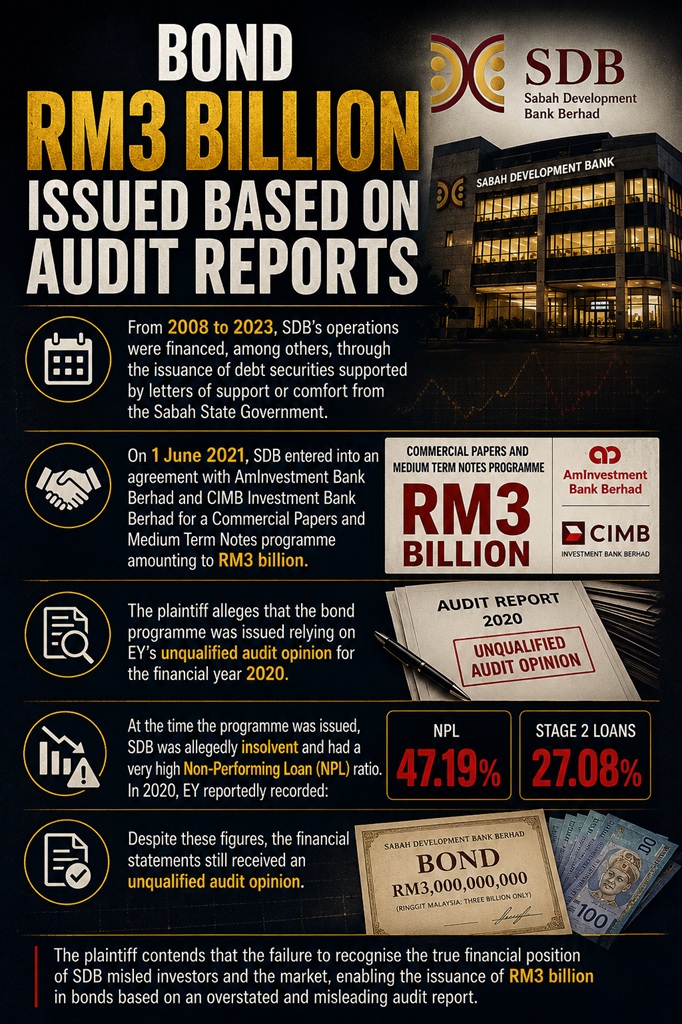
From 2008 to 2023, SDB’s operations were financed in part through the issuance of debt securities supported by letters of support or letters of comfort from the Sabah Government.
On 1 June 2021, SDB entered into an agreement with AmInvestment Bank Berhad and CIMB Investment Bank Berhad for a RM3 billion Commercial Papers and Medium-Term Notes programme.
The plaintiffs allege that the bond programme was issued in reliance on EY’s unqualified audit opinion for the 2020 financial year.
At the time the programme was issued, SDB was allegedly already insolvent and had an extremely high NPL ratio. In 2020, EY reportedly recorded NPLs at 47.19 per cent and Stage 2 loans at 27.08 per cent.
Despite those figures, the financial statements continued to receive an unqualified audit opinion.
The plaintiffs contend that had EY issued a qualified opinion, disclaimer of opinion or adverse opinion, SDB’s true financial position would have become known much earlier to its shareholder, bondholders, the Securities Commission Malaysia, the National Audit Department and other stakeholders.
The Sabah Government also allegedly would not have continued providing letters of support, placing deposits with SDB or allowing the bank to continue extending loans under such risky circumstances without corrective action.
Alleged Weaknesses in Credit Controls and CEO Influence
The Statement of Claim lists 21 forms of alleged negligence by EY.
Among them was the alleged failure to detect loans that fell outside SDB’s mandate, including financing extended to property developers and construction companies in Peninsular Malaysia. Some of these borrowers were allegedly rejected by other commercial banks because of weak property-market conditions or cash-flow problems.
EY is also accused of failing to report that SDB did not have a formal process to ensure that credit facilities remained within its institutional mandate.
Before 2021, the pre-screening process for loan applications was allegedly under the exclusive authority of the CEO. From 2021 to 2023, pre-screening was instead handled by an informal committee.
Until 2018, SDB allegedly had no independent credit-risk assessment function to review new loan applications and monitor existing loans. A credit-risk function was only established on 1 January 2021, but it reported to the Head of Banking and was allegedly still insufficiently independent.
The plaintiffs further allege that the CEO attended all Audit Committee meetings, raising questions over the committee’s independence.
EY is alleged to have failed to identify excessive CEO influence, weaknesses in internal audit, the absence of independent scrutiny over data controls, and breaches of single-customer and large-loan limits.
Internal Audit Allegedly Weak and Overly Focused on Compliance
According to the Statement of Claim, SDB’s internal-audit function was more focused on compliance than risk.
Internal-audit personnel allegedly lacked sufficient experience and competence. Audits were also said not to have been conducted comprehensively and effectively, exposing SDB to risks involving regulatory non-compliance, financial misstatement, fraud and internal-control weaknesses.
Minutes of Audit Committee meetings before 2023 allegedly show that discussions were cursory, without concrete remedial measures being taken to address identified control failures.
The situation was said to have changed after the new board and management were appointed in 2023, when internal-audit findings began to be followed by corrective action.
Threats to EY’s Independence Also Raised
The plaintiffs question EY’s independence after the firm continuously audited SDB from 2011 through 2023.
The period is alleged to have exceeded good auditor-rotation practices intended to mitigate familiarity threats.
The Statement of Claim also states that two members of SDB’s board had previous working experience with EY, allegedly creating a potential threat to the auditor’s independence and objectivity.
The plaintiffs further allege that some of EY’s audit plans contained generic or “boilerplate” elements despite SDB facing specific and serious credit problems.
5 June 2024 Meeting Alleged to Amount to an “Admission of Liability”
A meeting between SDB and EY representatives reportedly took place on 5 June 2024 to discuss weaknesses in the financial statements from 2017 to 2022.
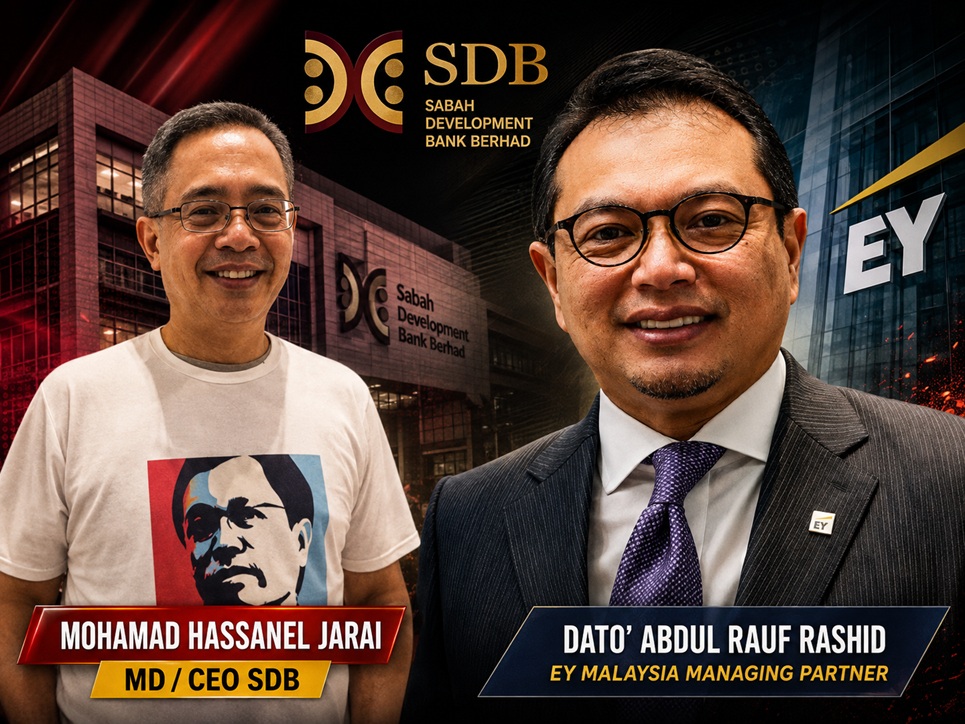
The meeting was said to have been attended by EY Country Managing Partner Dato’ Abdul Rauf Rashid; EY representatives George Koshy and Ahmad Siddiq Ahmad Hasbullah; SDB Executive Chairman Lim Haw Kuang; and SDB director Chen Yin Heng.
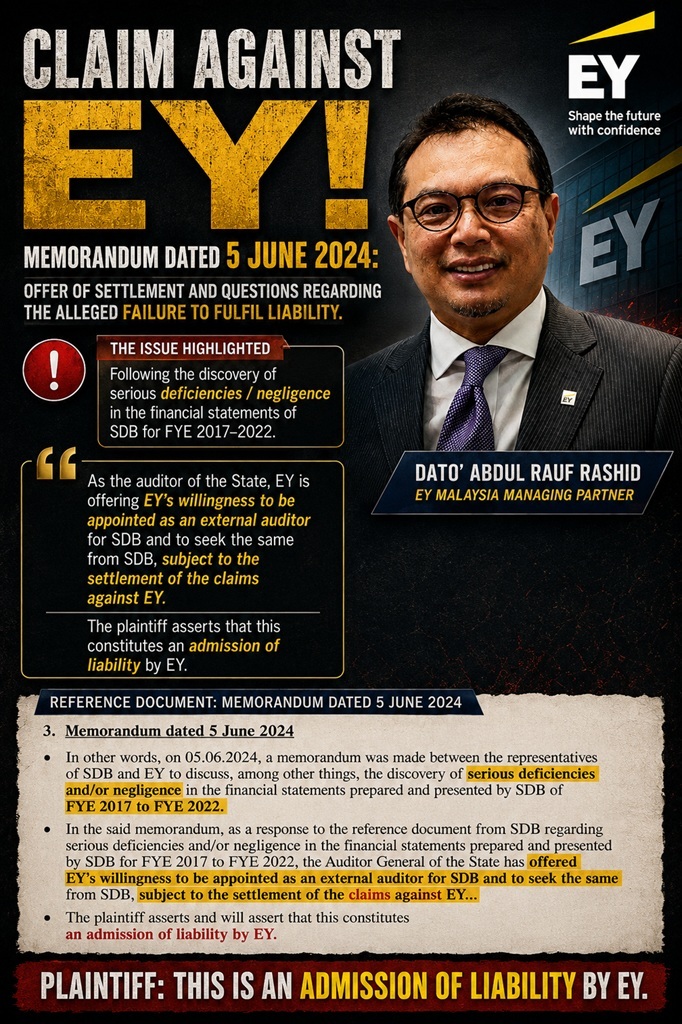
According to the Statement of Claim, after issues concerning inaccuracies in the financial statements were raised, EY’s Country Managing Partner offered for the firm to resign as SDB’s external auditor.
He also allegedly asked whether SDB wished to seek compensation from EY as a means of resolving the matter.
The plaintiffs characterise the offer as an admission of liability by EY.
However, whether the statement legally amounts to an admission remains a matter for the court to determine. EY is entitled to challenge the context of the conversation, the meaning of the statement, the admissibility of the evidence and the plaintiffs’ interpretation of it.
Six Legal Duties Allegedly Breached
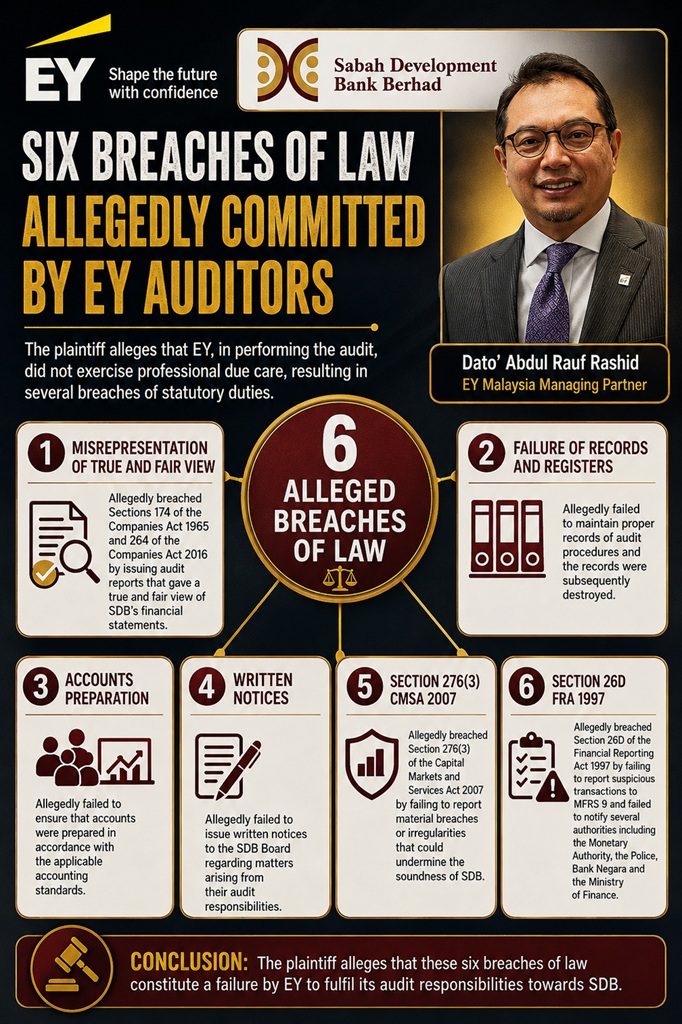
The plaintiffs allege that EY was not only professionally negligent but also breached several statutory duties.
First, EY is alleged to have breached Section 174 of the Companies Act 1965 and Section 266 of the Companies Act 2016 by failing to properly report whether SDB’s financial statements gave a true and fair view.
Second, EY allegedly failed to report whether proper accounting records and registers had been maintained.
Third, the firm allegedly failed to assess whether the procedures and methods used in preparing the consolidated accounts were appropriate.
Fourth, EY allegedly failed to provide written notice to SDB and its debenture trustees concerning matters that could affect the discharge of their responsibilities.
Fifth, EY is alleged to have breached Section 276(3) of the Capital Markets and Services Act 2007 by failing to immediately report to the Securities Commission Malaysia irregularities that might affect SDB’s ability to repay its debentures.
Sixth, EY is alleged to have breached Section 26D of the Financial Reporting Act 1997 by failing to report non-compliance with MFRS 9 and failures to comply with several International Standards on Auditing relating to fraud, internal controls, risk assessment, misstatements and accounting estimates.
Why the Sabah Government Says It Was Forced to Rescue SDB
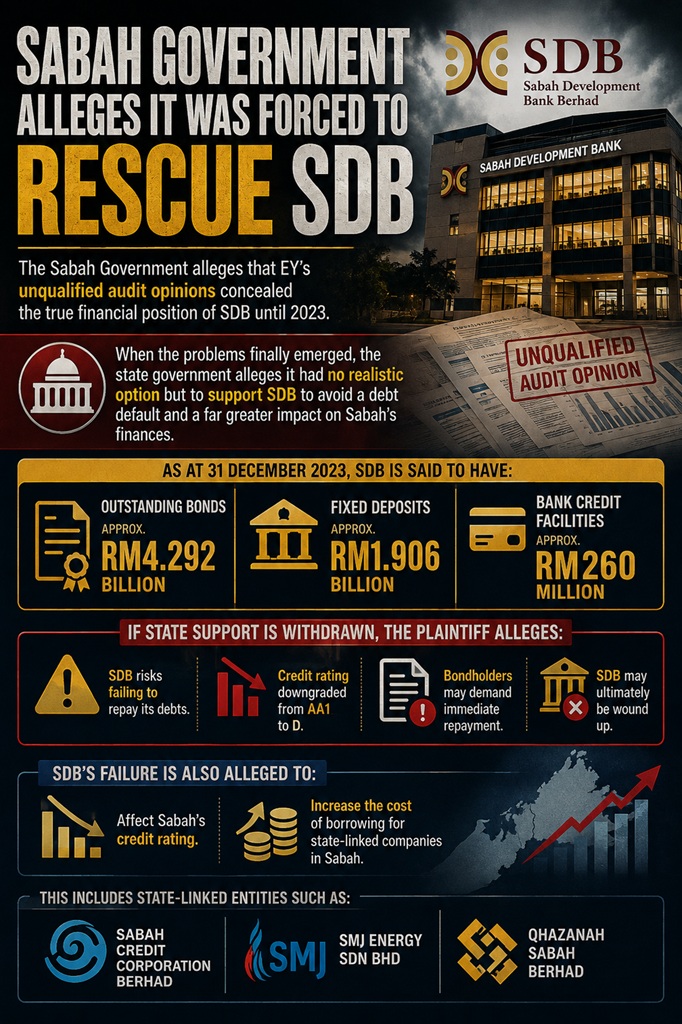
The Sabah Government alleges that EY’s unqualified audit opinions prevented SDB’s true financial position from becoming known until 2023.
When the problems finally surfaced, the state government claims it had no realistic alternative but to support SDB in order to prevent a debt default and potentially wider consequences for Sabah’s finances.
As at 31 December 2023, SDB was said to have approximately RM4.292 billion in outstanding bonds, RM1.906 billion in fixed deposits and RM260 million in bank credit facilities.
If state support had been withdrawn, the plaintiffs allege that SDB risked defaulting on its debts, being downgraded from AA1 to D, facing immediate repayment demands from bondholders and ultimately being wound up.
An SDB failure was also said to have the potential to affect Sabah’s credit rating and increase financing costs for state-linked companies such as Sabah Credit Corporation Berhad, SMJ Energy Sdn Bhd and Qhazanah Sabah Berhad.
Breakdown of the RM2.4 Billion Claim
The first loss claimed is RM650 million in Sabah Government fixed deposits. Through a State Ministry of Finance letter dated 14 November 2023, the government is said to have forfeited its rights to those deposits to support SDB.
The second loss is a RM90 million capital injection. RM40 million was paid on 13 December 2023 for the subscription of 40 million ordinary shares, while another RM50 million was paid on 3 October 2024 for the subscription of 50 million shares.
The plaintiffs allege that the new shares provided no additional economic benefit because the Chief Minister was already SDB’s sole shareholder and the Sabah Government was its ultimate beneficial owner.
The third loss is RM660 million in fixed deposits agreed to be converted into redeemable preference shares.
As at the date of the lawsuit, RM160 million had been converted — RM50 million on 30 July 2025, RM50 million on 30 October 2025 and RM60 million in May 2026.
A further RM200 million was scheduled to be converted by September 2026, while another RM300 million was due to be converted by the end of 2027.
The plaintiffs allege that the preference shares are virtually worthless and have no reasonable prospect of redemption.
The fourth loss is approximately RM1 billion representing the anticipated shortfall between SDB’s outstanding liabilities and the amount expected to be recovered. Those liabilities must be settled by September 2029 at the latest.
The Case Against EY
The 101-page Statement of Claim sets out detailed figures, chronology and serious allegations against EY.
Among the most important evidence expected to emerge at trial are EY’s audit working papers, communications between the auditors and SDB’s former management, Audit Committee minutes, collateral valuation reports, ECL calculations, Stage 2 and Stage 3 loan classifications, CAR calculations, and records relating to loan approvals and alleged “evergreening.”
Ultimately, the court will have to determine whether EY knew or ought to have known SDB’s true financial position; whether its unqualified audit opinions were defensible based on the information available at the time; and whether the alleged audit negligence directly caused the full RM2.4 billion in losses now being claimed.
The proceedings may also raise a broader and potentially explosive question: will evidence emerge showing whether any VVIP or other influential figure directed, pressured or influenced EY in relation to the treatment of SDB’s accounts?
For now, that question remains unproven and can only be answered by evidence produced in the course of the proceedings.
THE FOLLOWING IS THE COURT ACTION FILED BY THE SABAH GOVERNMENT, THE CHIEF MINISTER AND SDB AGAINST EY
