

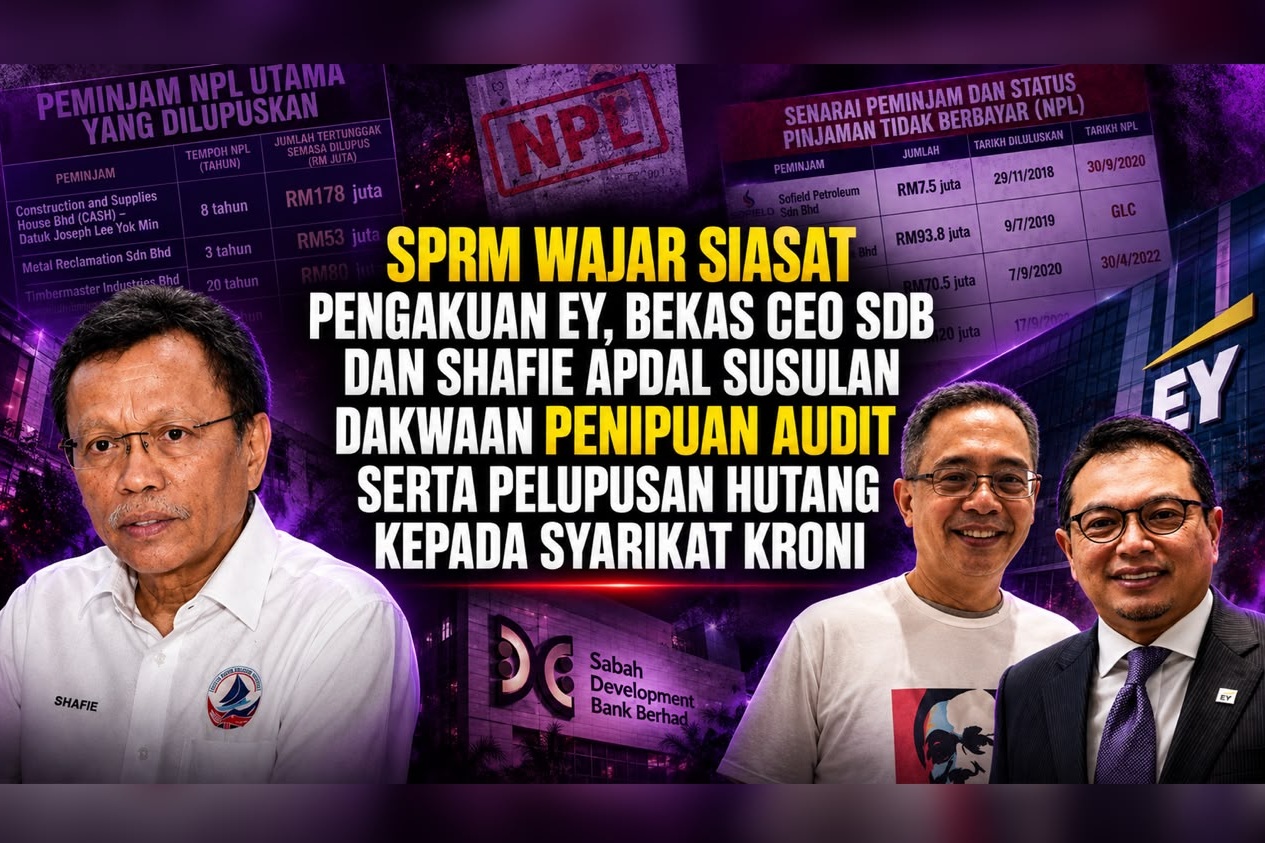
SDB suffered massive losses, while EY allegedly admitted its failures and offered to resign as the bank’s external auditor. EY also reportedly raised the possibility of paying compensation. MACC should therefore investigate this alleged admission: who instructed or pressured EY to produce audit reports that allegedly concealed SDB’s true financial position?
KOTA KINABALU: How could a Sabah government-owned bank report profits for 12 consecutive years when its non-performing loans had already reached nearly half of its financing portfolio—only for a new management team to uncover a crisis involving approximately RM5 billion?
That question cannot be answered by examining the external auditor alone.
The Malaysian Anti-Corruption Commission (MACC) has been urged to investigate Ernst & Young PLT (EY), the former chief executive officer and previous management of Sabah Development Bank Berhad (SDB), as well as key decisions made during the administration of Datuk Seri Mohd Shafie Apdal, when several major debts were allegedly restructured or written off.
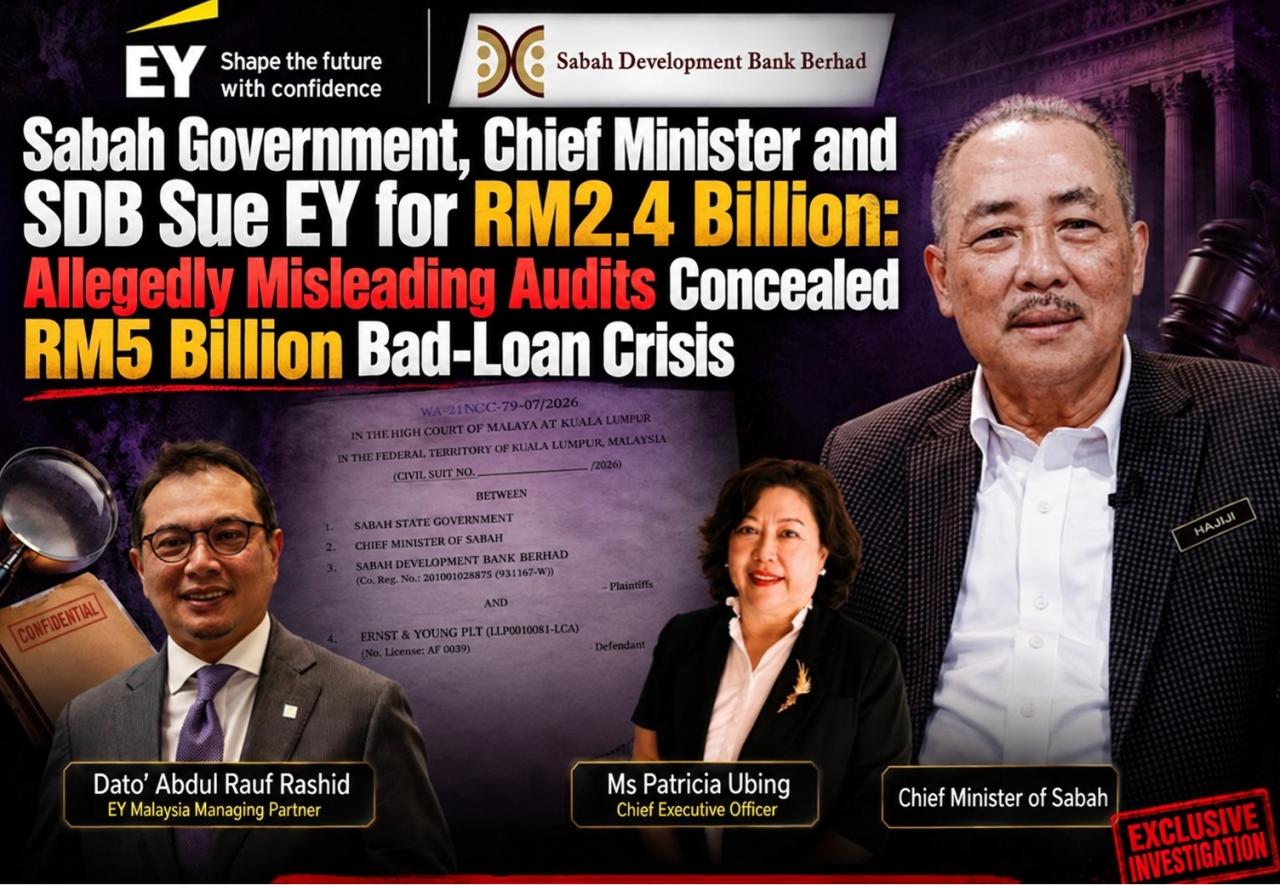
The call follows allegations contained in the RM2.4 billion civil suit filed on July 30, 2026, by the Sabah Government and related entities against EY. Proceedings in the case began on September 21.
RELATED ARTICLE — Sabah Government, Chief Minister and SDB Sue EY for RM2.4 Billion: Allegedly Misleading Audits Concealed RM5 Billion Bad-Loan Crisis
Sabahkini2 has been reporting on SDB’s troubled loan portfolio and controversial debt restructuring since 2024. Those disclosures have now become relevant to the serious allegations being examined in court.
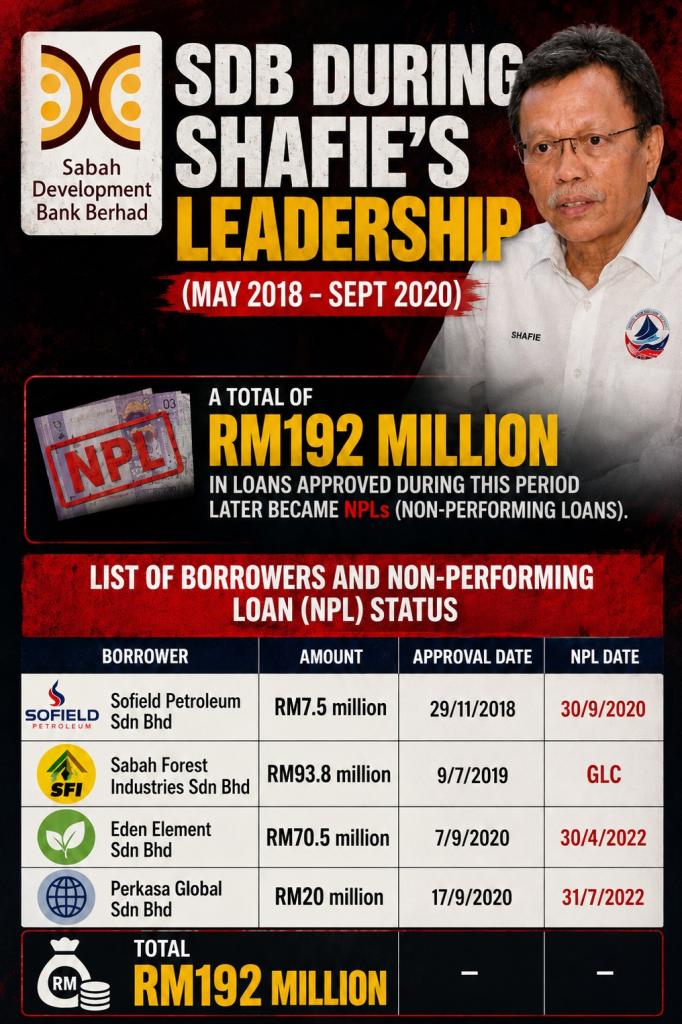
Shafie has repeatedly criticised the Sabah Government over SDB during State Legislative Assembly sittings and elsewhere. However, questions must now be answered about decisions made during his own administration, which allegedly recorded some of the most substantial debt write-offs and restructuring exercises.
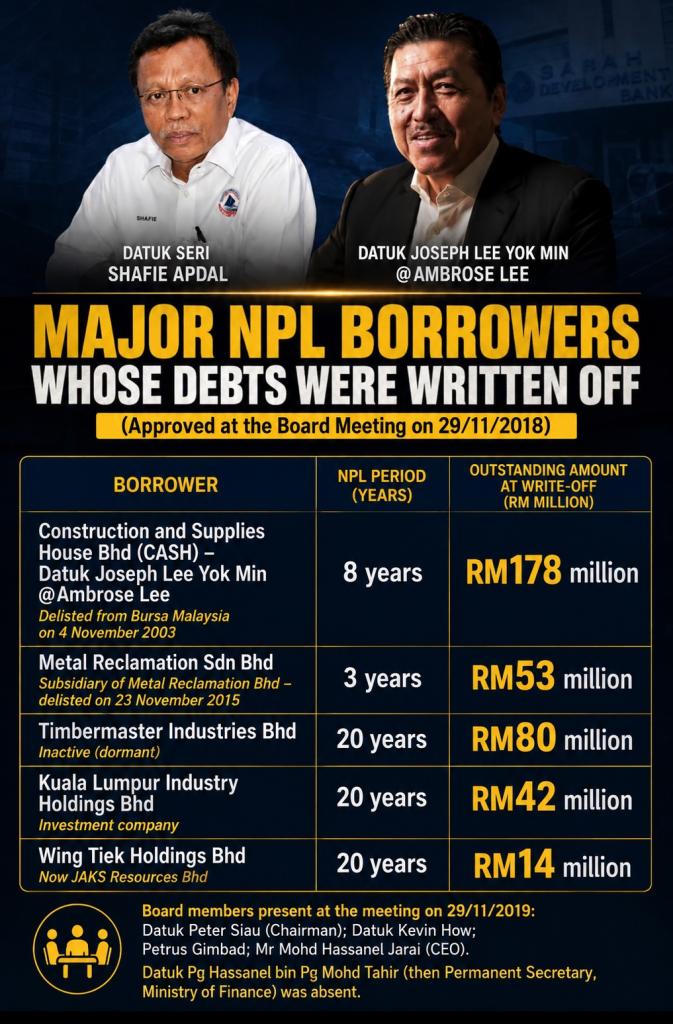
RELATED ARTICLE — July 11, 2024: Sabah Development Bank — Shafie Approved RM10 Billion Sukuk, RM178 Million CASH Bhd Debt Write-Off and Fresh Financing for NPL Borrowers
Sabah Finance Minister Datuk Seri Masidi Manjun has also addressed the matter in the State Legislative Assembly.
Twelve Years of Reported Profits, Followed by an RM878 Million Loss
Documents relating to the findings of SDB’s new management reportedly show that the bank recorded accumulated profit before tax of RM1.514 billion between 2011 and 2022 and distributed RM587.7 million in dividends.
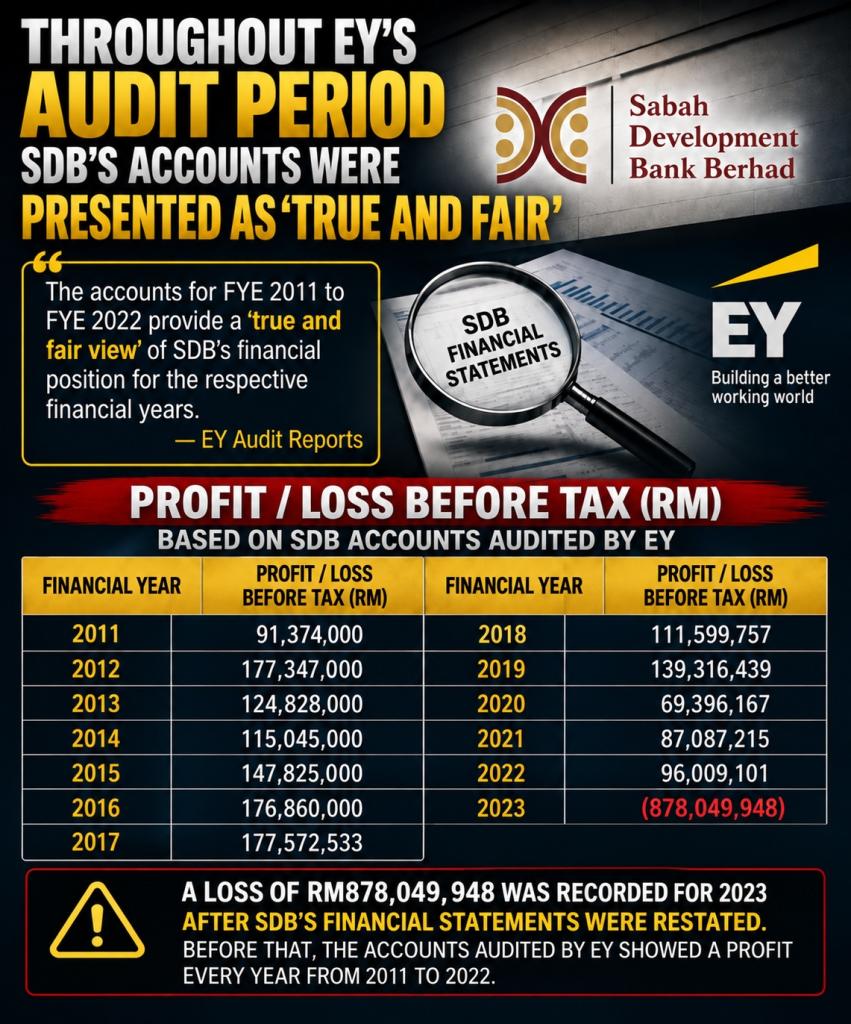
EY served as SDB’s external auditor throughout that period.
In 2023, after the new management reassessed the bank’s financial position, SDB recorded a loss before tax of RM878.049 million. This raises a fundamental question: what happened to the profits reported over the preceding years once the bank’s credit losses were fully recognised?
The plaintiffs’ case is that SDB was suffering losses while its financial statements continued to report profits that did not reflect the true scale of the deterioration in its loan portfolio. These allegations remain subject to determination by the court.
According to figures cited in the statement of claim, SDB’s non-performing loan ratio stood at 53.96 per cent in 2018, 48.44 per cent in 2019, 47.19 per cent in 2020, 46.92 per cent in 2021 and 47.46 per cent in 2022.
Following the subsequent reassessment, the ratio was listed at 72.15 per cent for 2023.
The figures suggest that severe credit stress had existed within SDB for years. Why did those warning signs not result in larger impairment provisions, clearer disclosures or more decisive recovery measures?
The year 2018 demands particular scrutiny. It was the year Shafie’s administration assumed control of the state government and, according to previous disclosures, a period during which certain distressed borrowers allegedly received additional financing while other debts were restructured or written off.
EY Must Explain What Its Audits Revealed
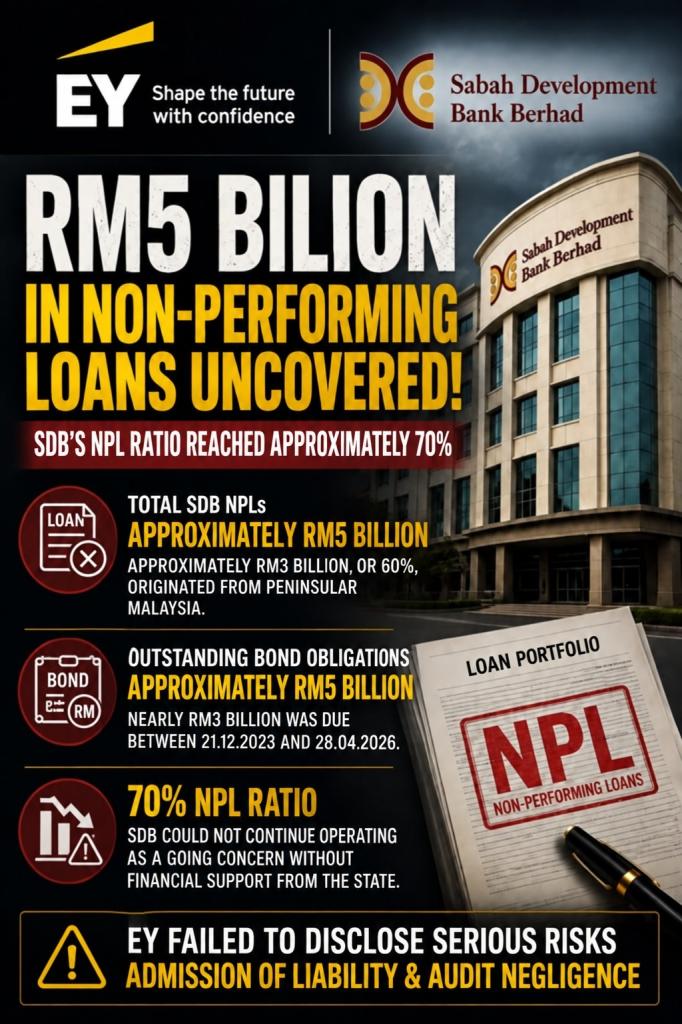
According to reports citing the statement of claim, the board and management appointed in 2023 discovered approximately RM5 billion in non-performing loans, representing nearly 70 per cent of SDB’s loan portfolio.
About RM3 billion of the troubled loans reportedly involved borrowers or projects in Peninsular Malaysia.
Companies linked to the Peninsular Malaysia portfolio were identified in a Sabahkini2 report dated August 3, 2026.
RELATED ARTICLE — New Evidence: Shafie Apdal Allegedly Approved RM178 Million CASH Bhd Debt Write-Off as EY Faces SDB Audit-Failure Suit
The plaintiffs allege that EY issued unmodified audit opinions on SDB’s financial statements from 2011 to 2022 despite indications of loan impairment and weaknesses in the bank’s credit-control system.
The allegations relating to collateral valuations are particularly disturbing.
The plaintiffs claim that some valuations relied upon by the bank had become outdated. Reports concerning the suit state that 12 out of 39 Stage 3 accounts used valuations that were more than four years old, while four relied on valuations that were more than seven years old.
Documents attributed to the new management further allege that some valuation reports were more than 10 years old.
If the collateral values were overstated, the credit losses that SDB should have recognised could also have been significantly understated. MACC and the relevant regulators should therefore obtain the original audit working papers, the dates of every valuation and all communications between EY and SDB’s former management.
For the 2017 financial year, the plaintiffs allege that EY failed to account for an additional impairment of RM962.45 million.
According to calculations presented in the suit, SDB’s reported capital adequacy ratio of 18.28 per cent should have been only 3.62 per cent after the alleged impairment was recognised.
The 3.62 per cent figure remains the plaintiffs’ calculation and has yet to be tested and determined by the court. Nevertheless, the vast difference requires a clear explanation.
Who prepared the loss estimates? Who challenged them? Who decided that no further adjustment was required? Who ultimately approved the figures published in SDB’s financial statements?
EY is one of the world’s Big Four accounting firms, alongside Deloitte, PwC and KPMG. That status carries a higher expectation of professional diligence and audit quality.
This case cannot be dismissed as a minor technical disagreement if the statement of claim is correct in alleging that the auditor knew a larger impairment was required but accepted the former management’s request not to make the adjustment because of concerns about SDB’s market financing and bond programme.
Former CEO and Previous Management Must Also Be Investigated
An investigation focusing exclusively on EY would leave the most fundamental question unanswered: who proposed and approved the loans that later became non-performing?
According to the allegations reported from the statement of claim, the loan pre-screening process before 2021 fell under the authority of the CEO. It was also alleged that an independent credit-risk function did not exist until 2018.
Credit committee records, board minutes, approval memoranda and recovery reports must show whether management officials received warnings about the borrowers but nevertheless allowed the financing to proceed.
The plaintiffs have also alleged that “evergreening” occurred, in which new financing was extended to distressed borrowers and then used to repay existing loans.
If transaction records confirm this practice, investigators must establish who proposed the new facilities, who authorised any exceptions, whether the borrowers’ repayment capacity was assessed honestly and whether any individual received a personal or improper benefit.
The former CEO and every officer who exercised approval powers at the relevant time should be called to provide evidence based on documentary records—not speculation or political assumptions.
Why Decisions Made During the Shafie Administration Must Be Examined
Shafie should be asked to explain what the Sabah Government knew and what decisions were made while he served as both Chief Minister and Sabah Finance Minister.
Was his administration informed about SDB’s non-performing loan ratio, its capital requirements, its major financing exposure in Peninsular Malaysia and the provision of further financing to borrowers who had already failed to repay their debts?
Who brought these matters to the state government’s attention, and what instructions were subsequently issued?
Reference materials have also linked that period to the alleged write-off of approximately RM178 million owed by Construction and Supplies House Berhad, or CASH Bhd, a company associated with Dato’ Ambrose Lee, whom Sabahkini2 has described as being close to Shafie.
MACC should independently examine the approval file and commercial justification for that transaction, including whether it formed part of the loan portfolio now being disputed.
June 5, 2024 Meeting and EY’s Alleged “Admission of Liability”
One of the most significant allegations in SDB’s suit concerns a meeting held on June 5, 2024, involving members of EY’s Malaysian leadership.
According to SDB’s claim, the meeting was convened to discuss alleged weaknesses and inaccuracies in the bank’s financial statements for the years 2017 to 2022.
The meeting was reportedly attended by Dato’ Abdul Rauf Rashid, representing EY Malaysia’s leadership, together with George Koshy and Ahmad Siddiq Ahmad Hasbullah. SDB was represented by its Executive Chairman, Lim Haw Kuang, and director Chen Yin Heng.
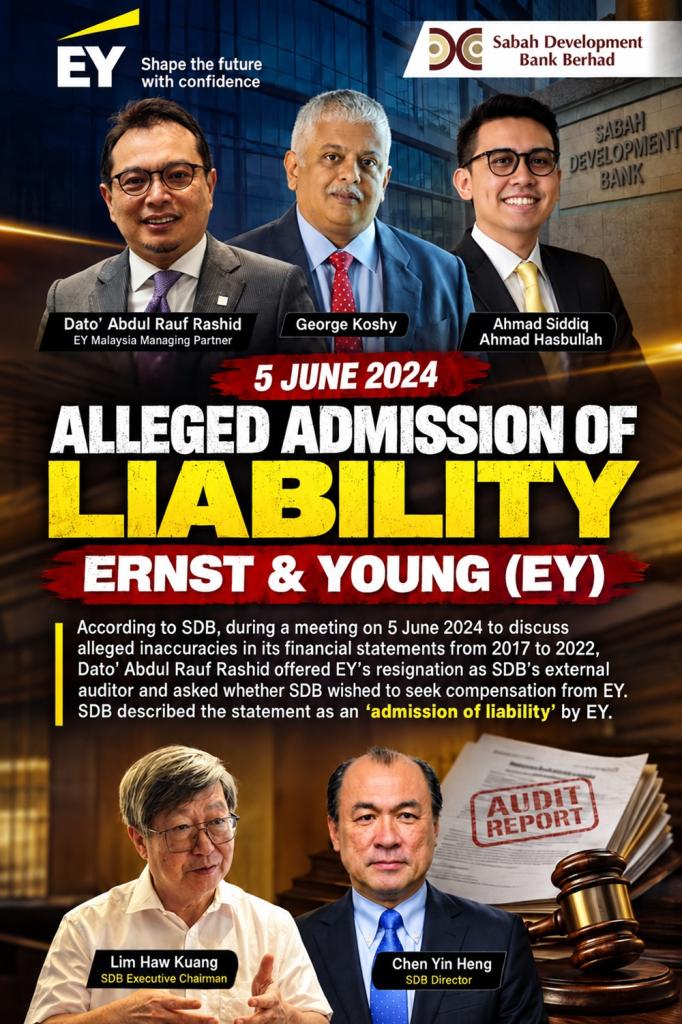
Central to the dispute is Abdul Rauf’s alleged response after the audit issues and inaccuracies were raised.
SDB claims that he offered EY’s resignation as the bank’s external auditor and asked whether SDB wished to seek compensation from EY as part of a possible resolution.
SDB now relies on that conversation as an important part of its case, describing the alleged statements and conduct as an admission of liability by EY.
Whether the conversation occurred exactly as alleged—and whether it legally amounts to an admission of liability—must ultimately be tested in court.
However, if SDB’s account is proven, EY must explain why the possibility of compensation and the auditor’s resignation arose when concerns about the audits were raised.
The June 5 meeting could therefore become a pivotal episode in this dispute. It concerns not only alleged audit failures, but also whether EY’s own leadership had recognised that the problems were serious enough to discuss resignation and compensation.
If EY believes an out-of-court settlement is appropriate, it may choose to negotiate compensation with SDB. Otherwise, the RM2.4 billion suit is likely to subject the firm’s audit work and internal decision-making to prolonged scrutiny.
EY has previously faced lawsuits and regulatory action in other jurisdictions. However, the allegations involving SDB could become one of the most serious audit controversies involving the firm in Malaysia if they are proven.
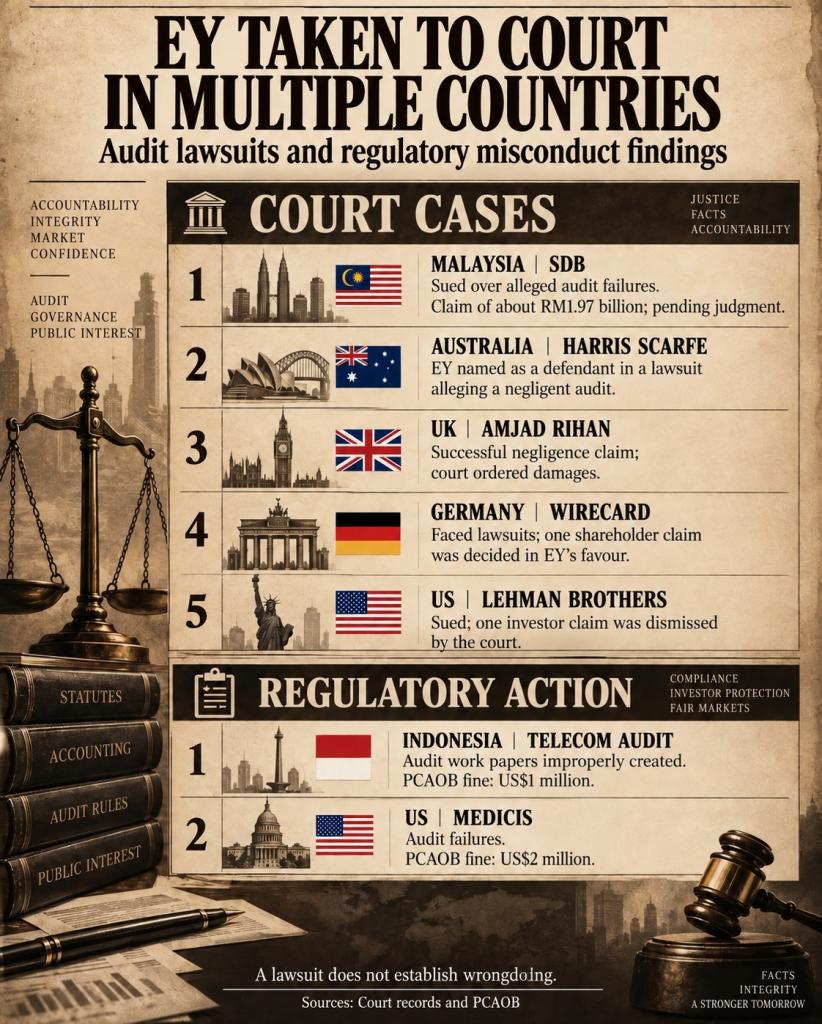
The RM2.4 billion claim is a civil case. Nevertheless, a corruption investigation may proceed separately if evidence points to bribery, abuse of power, conflicts of interest or improper benefits.
MACC should compare EY’s audit working papers with SDB’s loan files, collateral valuations, credit-loss calculations, meeting minutes and the movement of funds to borrowers and related parties.
Investigators must answer two central questions: was SDB’s true financial position deliberately understated, and who benefited from the decisions that allowed the situation to continue?
The investigation must not stop with the auditor.
It must extend to the former CEO, previous management, members of the relevant committees, government officials involved in the decisions and every party that benefited from new financing, restructuring or debt write-offs.
If EY had identified serious weaknesses but failed to ensure they were properly reflected in SDB’s financial statements, the public deserves to know why. If former management pressured the auditor to suppress the full extent of the losses, those responsible must be identified.
And if political or commercial influence allowed distressed borrowers to continue receiving financing or obtain favourable debt write-offs, MACC must trace the approval trail and follow the money to its final destination.
